FOHXG visits Foster Botanical Garden

By Heidi Bornhorst

On a windy and sometimes rainy day, Wednesday March 6, 2024, some board members and volunteers from the Friends of Halawa Xeriscape Garden (FOHXG) got a tour of Foster Botancial Garden (FBG) led by Botanist Naomi Hoffman and coordinated by Education Program Specialist Iris Fukunaga.

Did you know that FOHXG, our non-profit garden support group, was modeled on the Friends of Honolulu Botanical Gardens?  (Mahalo to FOHXG founding member Paul Weissich, Director emeritus of the Honolulu Botanical Gardens)

We had a great tour seeing some of the fabulous historic and XERIC trees and plants.

Including was the Quipo, a giant fat trunked, water storing tree from South America and its African counterpart the Baobab tree.

We saw a super rare and Exceptional Tree, the Loulu palm known scientifically as Pritchardia lowreyana.  It is more than 150 years old, but very slow growing.  It was originally collected in Nuʻuanu Valley by the garden’s first Botanist Dr. William Hillebrand and was planted in 1851.

It is now extinct in Nuʻuanu.  Happily, Botanist Hoffman informed us that a new population of this rare palm was found in 2008 by Joel Lau and Kenji Suzuki, just below the summit of Pu`u Ohulehule (this is the ridgeline that separates Waikane and Kahana Valleys).

We saw the Double Coconut, Coco de Mer, whose fruit take six years to fully mature and becomes viable to grow new palms. The fruit were the happy horticulture result of hand pollination by Plant Propagator Romel Silva, with pollen air mailed from the Singapore Botanical Garden.

We took a group photo amidst the buttress roots of the Kapok trees, two of which grace upper terrace.

After our tour we had home lunches in the FBG classroom and shared special tasty treats, some from as far as Hokkaido (Mahalo Doug!).

Iris Fukunaga talked to us some more about upcoming educational and volunteer opportunities among our shared gardens.

Note: HBG will be holding their Midsummer Night’s Gleam on Saturday July 20, 2024, for the first time in four years (post COVID). They are looking for volunteers and keiki activities.

Ohi’a Lehua – State tree of Hawai’i

Ohi’a lehua (Metrosideros polymorpha) is a flowering tree endemic to the islands of Hawai’i.  Proclaimed the state tree of Hawai’i, it is the most common native tree in the state.  It is a highly variable plant as it can be seen as a tree or a shrub, and the flowers can be red (most common), orange, pink, yellow or white (most rare).

In Hawaiian mythology, Ohi’a and Lehua were two young lovers.  The goddess Pele fell in love with Ohi’a but he rejected her advances.  In a fit of jealousy she turned Ohi’a into a twisted gnarly tree.  Lehua was devastated and the other gods took pity towards her.  They turned Lehua into a flower and placed her on the tree.  Legend has it that if you pick a lehua flower off of an ohi’a tree, it will rain.  Tears from heaven for separating the two lovers.

In recent years, a strain of fungus has attacked the ohi’a forests on the Big Island.  Once healthy trees would die in a matter of a few days or a few weeks.  This is referred to as Rapid Ohi’a Death (ROD).  Many native birds and insects rely on the ohi’a lehua and the ohi’a diminishing numbers has caused many of these species to become endangered.  Luckily there is an organization called Ohi’a Legacy Initiative.  The vision of this organization is “to make the ohi’a lehua tree a symbol of the Hawaiian Islands, to spread awareness of native plants, perpetuate Hawaiian culture, provide habitat for native birds, and increase the health and vitality of the land for the people of Hawai’i.”  The Ohi’a Legacy Initiative gives away ohi’a plants so that they will become a common feature of residential gardens and public places.

Having received my plant in 2019, here is my very first ohi’a lehua blossom:

This color variety is called “lehua mamo”.

Little Plumeria Farms Field Trip

Sixteen FOHXG members took a field trip to the Little Plumeria Farms on the North Shore.  Plumeria (Plumeria rubra) although often associated to the Islands especially in lei-making, is not native to Hawaii.  The farm was established in 1973 by Jim Little and specializes in rare plumerias and developing exciting new hybrids.  The group got to see many different varieties of plumerias that come in many different colors, shape, and smell.

Here, Clark Little (in yellow) gives a talk to the “Friends” on the history of Little Plumeria Farms and their work in developing new cultivars.  Next to Clark is his son, Dane, who represents the third generation of Little Plumeria Farms.


Although plumerias can be propagated through seeds, we were taught how to grow via cuttings.  It’s been about a month after planting this cutting.  Waiting for new leaves to appear.


Go Native!

When considering plants for your home garden… go native! Native Hawaiian plants are beautiful, beneficial to our ecosystem, tend to be “unthirsty”, and many are becoming extinct.
Where can you get native Hawaiian plants? As many of them are endangered, DO NOT, I repeat, DO NOT collect them in the wild. You can get them from friends, neighbors, private hobbyists, or your local nursery or garden shop.
There are two categories of “native” plants: Endemic means that these plants came on their own via the ocean currents or carried by the wind. Then over thousands or millions of years they evolved into a plant that is totally unique to Hawaii. Indigenous means, again that they came on their own, but remained unchanged and can be found in other parts of the world.
Plants that are NOT native are those that were brought here by humans. When the early Polynesians came to Hawaii they brought with them plants that they needed to survive. To name a few, “ulu” (breadfruit), “kalo” (taro), and “kukui” (candlenut). Many of these plants have been incorporated into the Hawaii ecosystem. Unfortunately many compete with the native plants and are now considered “invasive”. According to the Hawaii State Alien Species Coordinator (DLNR), the “awapuhi” (white and yellow ginger, commonly used in leis) is on the list of Hawaii’s Most Invasive Horticultural Plants. We at Halawa Xeriscape Garden kindly ask that you do not grow these plants.
At Halawa Xeriscape Garden we highly encourage growing native Hawaiian plants as they are well adapted to growing in our climate and tend not to need a lot of watering. Your garden will show your love of Hawaii if it has the “ma’o hau hele”. A beautiful yellow hibiscus which in 1988 was designated as Hawaii’s state flower. If you want something easy to grow try the “pohinahina”. A sprawling ground cover which is drought, wind, salt, and heat tolerant. It has silvery green leaves which has a pleasant sage-like aroma and clusters of lavender flowers. The early Hawaiians ate the leaves of the “pohinahina” to cure stomach ache and insomnia. Also consider growing the “ohi’a lehua”. Although the most abundant native tree, in recent years hundreds of thousands have died due to a fungal disease referred to as Rapid Ohia Death (ROD). Normally growing in Hawaii’s rain forests, the trees are not necessarily “unthirsty”, but they help to maintain a healthy ecosystem, provides a habitat for native Hawaiian birds and effectively replenishes our aquifers. There is an organization called Ohi’a Legacy Initiative which, in their effort to establish ohi’a trees in residential areas, will from time to time giveaway ohi’a plants.

Ma’o hau hele

Pohinahina

Ohi’a lehua

If you need advice on how to grow native Hawaiian plants check out the book, “Growing Native Hawaiian Plants” by Heidi Leianuenue Bornhorst.

The Beautiful Echinopsis

Cactus is a succulent belonging to the Cactaceae Plant Family.  They come in many different forms but basically consist of a water-storing body and covered with areoles from which sharp spines protrude.  These spines or thorns are actually leaves that had evolved to be sharp and pointy.  With about 1750 known species, cacti comes in all different shapes and sizes.  Some resemble trees (Saguaro), some climb on long branches (Dragon Fruit), some have stems that look like ping-pong paddles (Prickly Pear), and many are shaped like barrels.  One of the most beautiful of the barrel cacti are of the genus Echinopsis.  Echino meaning hedgehog or sea urchin and opsis meaning appearance.  Echinopsis is a large genus of cacti native to South America.  They are known for their spectacular flowers borne on long tubes and often bigger than the plants themselves.

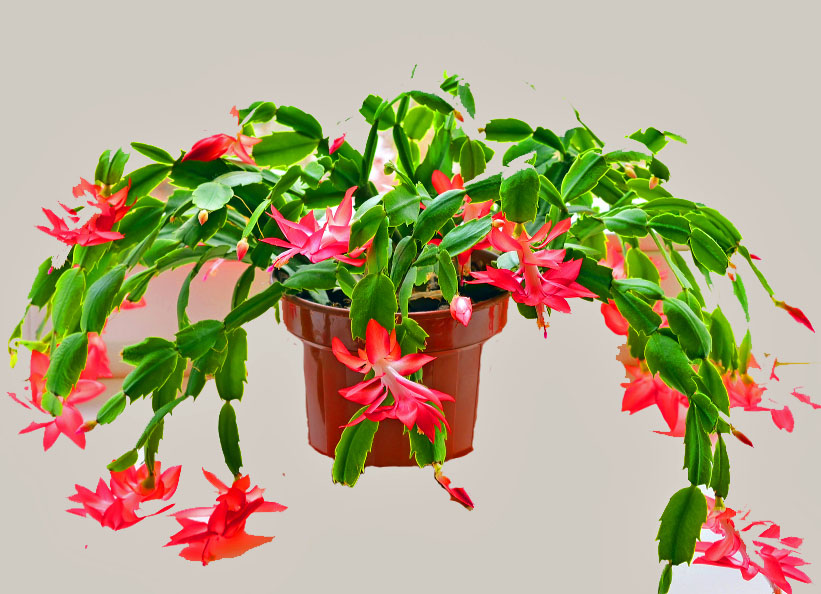
Taking Care of Your Christmas Cactus

Along with the poinsettia, the Christmas cactus is another plant that flowers for the holidays.  Although the Christmas cactus does not look like your typical cactus, it indeed belongs to the Cactus family.  It is an epiphyte (like the orchid, bromeliad and tillandsia) and in its natural habitat it typically grows on tree branches and rocks.  It is native to the mountain rainforests of Brazil which explains why it needs special care in order for it to thrive.  And under the right conditions, your Christmas cactus will live for decades.

Plant your Christmas cactus in soil that provides superior drainage and only water when the surface soil feels dry.  The Christmas cactus does not like a drafty location and prefers cool temperatures (ideal temp is 68 degrees F).  Being a tropical cacti, it thrives in the shade and high humidity.  It works well as a house plant and misting will keep it happy.  Flowering is triggered by shorter days and cooler temperatures.  To force buds to form, put the plant in complete darkness for 14 hours each night.  Once the buds form, move to a brighter location for the flowers to bloom.  Be aware that too much light will burn the plant.

Most of the Christmas cactus you see today are cultivars of the genus Schlumberger and the flowers comes in red, pink, orange, purple, white or yellow.  According to the College of Tropical Agriculture & Human Resources, UH Manoa, the Christmas cactus does well in Hilo.